Let’s Play! A Conversation with Stuart Brown, MD
/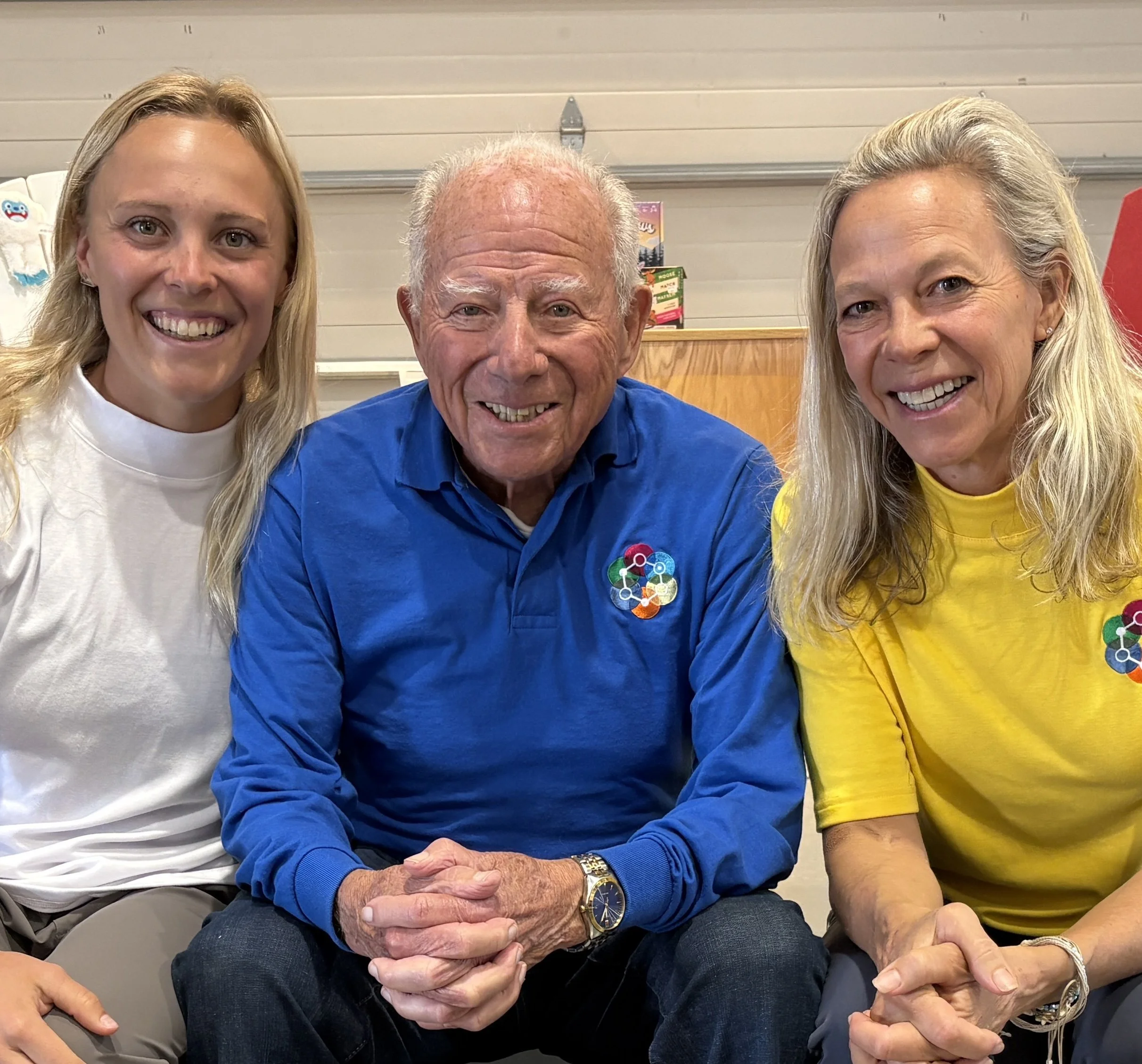
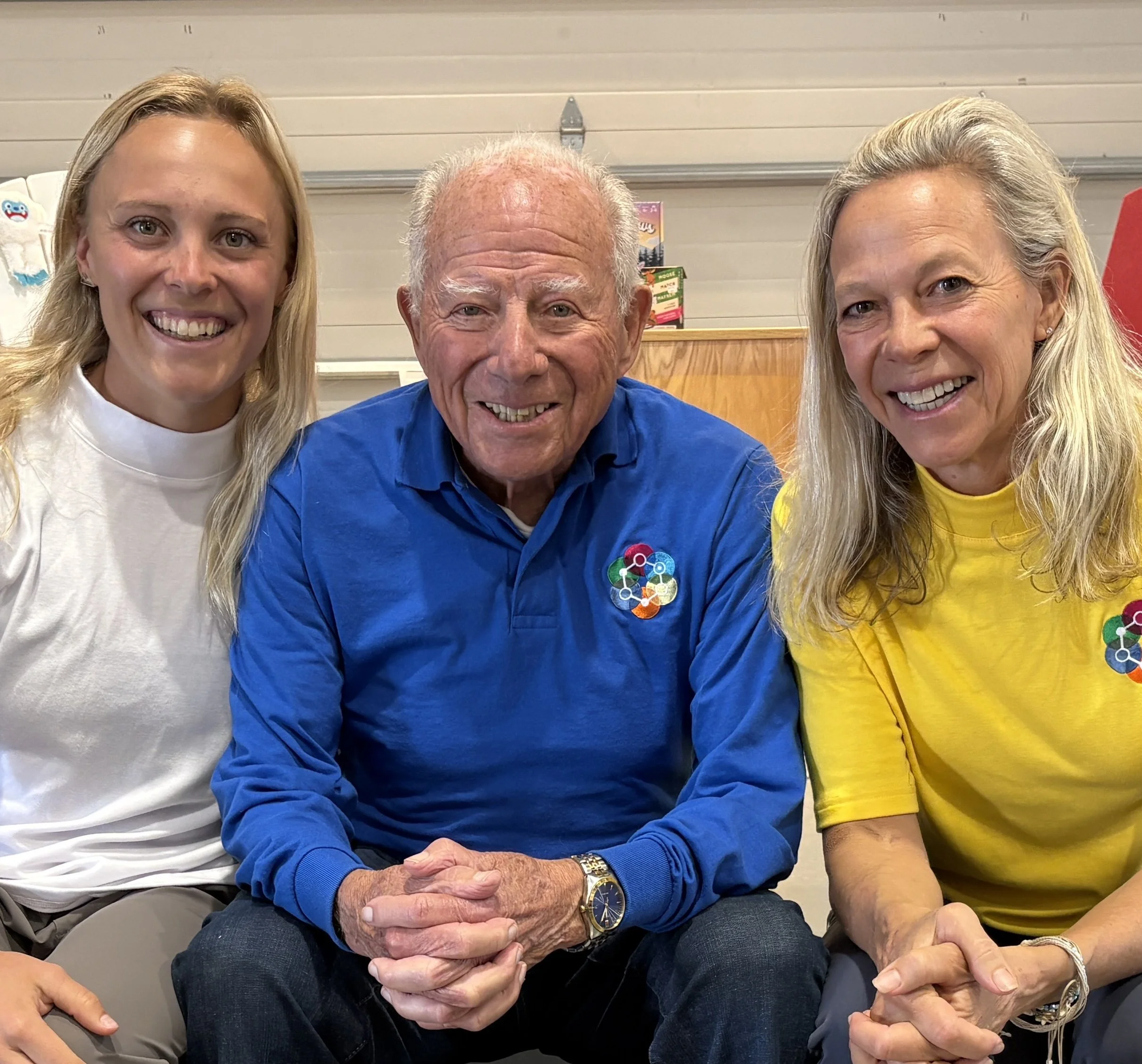
from left: Mia Sundstrom, CEO; Stuart Brown, founder; Lauren Sundstrom, COO of the National Institute for Play | Photo used with permission from stuart brown
When we think about play, many of us may think of childhood—of running around a playground, of a backyard sprinkler in the summertime, of toy trains and made-up stories of adventure. Few of us may even consider play’s pertinence in adulthood, but research indicates that play is not just a hallmark of childhood. It’s a necessity for well-being throughout our lives.
As you’ll soon discover, play is also linked with creative thinking, productivity, positive coping, positive emotions, overall well-being, and life satisfaction (Shen & Masek, 2024). So, as we consider what makes life worth living, perhaps it’s time to take a closer look at play. And when we feel pressured by our society, our circumstances, and ourselves to be serious, productive, and blah blah blah, we may actually need to let loose and do something fun instead.
So, to kick off our summer issue, we called on two alumni of Penn’s Master of Applied Positive Psychology (MAPP) program who had a thing or two to share about play—as a pathway to authenticity and a strategy for navigating uncertainty and change. To wrap things up, we spoke with psychiatrist, researcher, and founder of the National Institute for Play (NIFPlay), Stuart Brown, who has been studying the topic for 60 years. His daughter and COO of NIFPlay, Lauren Sundstrom, also joined the conversation.
In gratitude for and honor of two lives lived incredibly well, we dedicate this issue to Dr. Isaac Prilletensky and Dr. Ora Prilleltensky, who each passed away in May 2026. Isaac, a beloved lecturer on community well-being and mattering in the MAPP classroom, was both playful and inspiring. He was a fantastic teacher who not only lived and loved well, he made us laugh! Both he and Ora will be sorely missed. But in their honor, please grab a friend, and after you read this issue, go play!
MAPP Magazine (MM): Please share a bit about yourself, your work, and its intersection with positive psychology.
Stuart Brown (SB): Well, you know, I’m an old guy, so we’ve got only an hour, I could go on and on. But I’m a former president and founder of the National Institute for Play, and I’m obviously old enough to now be just the founder.
When a mass murder took place in the University of Texas tower, it was the largest mass murder in the history of the US [at the time]. And our very detailed study of [the murderer’s] life and death indicated he didn't play, and that led to my spending a year in the Texas prison system and having the help of a statewide inventory of people who were matched with homicidal individuals in the prison system to check and really see if there were substantive differences between the homicidal individuals and their match controls. And indeed, this was a very enlightening experience in that the homicidal individuals had huge deficits in their play history and in their play experience. So that's a long time ago. We're talking 1966.
But since then I've had the pleasure of spending four years with the National Geographic studying wild animals at play and have also, as a clinician, reviewed a few thousand individual play histories and in the course of the last few years have done a bit more assembling of the research both in human and in animal play to try and get a better idea of, well, what is play anyhow. And the source of a lot of positive psychology is the enchantment that comes along with being human, the human instinct to play, so we're on parallel paths.
MM: Thanks for sharing your story a bit. For some, it may be easier to understand kids playing, but less obvious what play means in an adult context. When you talk about play, how do you define it?
SB: Well, it's very hard to define because it's been around for five hundred million years or so. It is pre-verbal in its evolutionary history, so that to describe the varieties of play, which are immense, is a little bit like love. It's not something that lends itself easily to a simple linear definition. But, you know, I think play is done for its own sake. It is enjoyable. It produces mood changes that are positive, and it has many, many benefits that we can probably get to in our discussion today.
But to define it, I think, is often a bit like taking a joke and analyzing it. It's an experiential process. What's your play may not be my play. You know, maybe playing with my dog on the beach is fun for me, but for some people, collecting stamps is their joy.
MM: Yeah, definitely. I can understand that. And, like you said, play has a lot of benefits, and that's obviously another topic that I want to get into. You’ve suggested that play is not only critical to childhood development but also to adult well-being. Why is that? What are some of the benefits for adults?
SB: Well, it is different for infants and children whose lives are often dominated by what gives them gleefulness and joy and what engages them spontaneously, whereas the complexity of adult life and culture and gender and all of the vicissitudes of growing up mean that there's plenty else besides pure play for adulthood. However, the capacity to respond contagiously to your own play nature stays throughout your lifetime. It may not be as central in adulthood or late adolescence as it was when you were five, but it's still a part of life.
I think one of the messages for the National Institute for Play is to say, "Look closely at your own life as an adult and take a look at whether or not you've got a play deficit." And chances are, if you do, you're gonna be grumpy, you're gonna be mildly depressed, you're gonna be not deeply engaged in what you're doing or what you love because you will be play-deprived. So, it exists as being significant throughout the lifetime.
It is absolutely critical for well-being, socialization, and resiliency in infancy and childhood as a part of development. But it is also important throughout life, including a memory care center, for example, where a song that you once heard as a kid that you loved, you hear again, and you get that same upbeat emotion from experiencing the play again.
MM: Sort of related to that is, I think some people might be skeptical of the importance of play. What would you say to skeptics who may consider play as you’ve described it as a first-world privilege or a luxury their daily responsibilities and realities cannot afford?
SB: Well, I think the thing that is fascinating is even with a skeptic, you can generally find some area of their life that gives them joy. And emphasize that and say to them, "Why is it that this jazz band or collecting stamps or being on a hike in nature—why do you get a sense of joyfulness and mood change with that?" And they begin to recognize that their lives are gonna be better if they're attached to their own play and living it out.
MM: Great. You've mentioned that there are different types of play, right? What can you tell us about the play personalities and how might they help adults tune into their playful side?
NOTE: The National Institute for Play has identified six play styles through thousands of play history assessments, and similar to character strengths, you have all of them to varying degrees. The styles include the Creator, Explorer, Competitor, Organizer, Dreamer, and Mover, of which each includes various subtypes. Intrigued? Take the play styles assessment here.
SB: This is where I think about early parenting and observing an infant. Who is this little bundle of joy and crying and diapering and all that, that came my way? What is it that engages them and produces spontaneous joy? And we usually can see that there is a play personality, that they like movement or music or touch or a variety of interests, joyful evoking circumstances, and that's part of their nature.
You know, I could ask that of you, you could ask that of me, and you usually get a sense that there is a personal preference that becomes modified with life that is nonetheless one's play personality. And there are a number of ways of identifying them. It's not good science to say, you know, you're an explorer or a musician or an artist. But usually, you can find within the history of an individual, particularly if they're open to exploration, what it is that produces a sense of happiness, joy, engagement, motivation, innovation, imagination. And usually you can find it.
MM: Great. Um, just a side question. What play personality are you?
SB: Well, right at the moment, I'm recovering from a hip replacement. So I'm playing with the new body that I've received from the skill of the orthopedist. It's a little different than it was. And I'm a mover. I like hiking. I like biking. I like being outside. I live in a lovely area of central California, the Carmel Valley. Today's a beautiful spring day, and, being out for a walk, even with a bad hip, is a joy.
So, you know, it has varied some probably. Any of us in the course of a lifetime may take on some different emphases as far as our play personality. But, for example, you know, if I'm lucky this afternoon, my daughter and I will go to the beach with Cookie, the wonder dog, and watch Cookie play on the beach with other dogs, and that'll be our play.
MM: That sounds perfect, and I'd like to join in on that. One sort of broader question is, in what ways can play change our perspectives—of ourselves, of others and our relationships to them, and the world?
SB: That's a tough question and very broad. But I would say, if you are true to your play personality so that you pay attention and prioritize what it is that motivates you, what engages you, what gives you a sense of resiliency and purpose, and a sense of authenticity as it's related to play.
That's not generally part of our culture. We tend to think of it as trivial and something unnecessary in adulthood. And yet it is my perspective over the years of studying it that it's a very, very significant part of personal compassion, empathy for others, sense of purpose of oneself, authenticity of self, so that it is a highly significant component and very much related to the emphasis that MAPP has, which is on positive psychology.
MM: Definitely. What practical suggestions do you have about how we can all incorporate more play in our lives?
SB: If you think about how significant it is to well-being, for resiliency, for your life, I would say when you're brushing your teeth in the morning, and you look at yourself in the mirror, you ask, "Well, what am I gonna do today that's different?” Do I look at today as if it's a drag and I can't wait for the weekend," or something of that sort. If you prioritize that this is an important part of well-being, it's as significant, in my view, as handwashing and teethbrushing—as a play hygiene, that makes sense to me. I think if that became a part of our public consciousness in childhood and adulthood, I think we'd treat each other better, and I think we'd have a more civil society.
MM: I love that—as important as teeth brushing—that's definitely a change in perspective that I think we need. Is there anything specific that you're interested in related to play? Any specific effects or manifestations right now?
SB: Well, I've had more time to be sedentary, as I've recovered. And in that process, I think one thinks about how to deal with aging. I'm an old guy, and the loneliness, the lack of immediate deadlines that once dominated life—you need to adjust. But if I go to the grocery store, for example, how can I bring a little bit more pleasure to the clerks and the people who are working their butt off serving me at the grocery store? And so that there is a kind of a way of life at whatever stage you are in, which you prioritize play.
And I think it's different. In preschool, for example, where your life is dominated by the play drive, play is central. And in those instances, I think there has to be a healthy balance between honoring play and setting limits, which is a normal parental or teacher prerogative. It doesn't mean you control or overcontrol them, but it does mean that there's a certain requirement for achieving adulthood that usually means you have to be guided by adult values.
MM: Yeah, it's interesting, the idea of play changing as you age. I think that's an important topic as well with changing abilities and things like that. So thank you for speaking about that.
I was just thinking about where I live. I live in New York City, but in the bottom of my building is a preschool, and there's a courtyard out my window. So while I'm sitting here, working, there's often lots of yelling kids and happiness and all of those things. So that's always a good reminder that I should get outside and get playing.
SB: Yeah, there is something contagious about the noise of the playground. And the spontaneity and the naturalness, and the sense that this really is a fundamental element, necessity of being fully human, is playing with others, playing in a space that is designed and works for play.
MM: Yeah, it is such a good balance and good reminder. Is there anything else that you'd like to share or that you would've liked me to ask about?
SB: I think the concept that play is a public health necessity throughout life. It hasn't really penetrated our industrialized, highly technical culture. And yet, if we are going to live by the evolution that designed us to be fully human, we need to include play. So the play deficit, if it's seen in a little child, is an important public health issue. Play deficit in a lonesome aged person is a significant health issue.
One of the questions that I would ask your group is to include the concept that play is important throughout life, and that it is a necessity if you're gonna have empathy and compassion and the ability to get along with people who you're different with.
You know, if you dance with them, chances are you're not gonna get paranoid about them. You're gonna see the differences and live through [them]. So this is not a minor cultural enlightenment. It's a necessity.
“If we are going to live by the evolution that designed us to be fully human, we need to include play.”
MM: How can readers learn more about your work?
Lauren Sundstrom (LS): There’s the National Institute for Play website. And it's kind of interesting to note that I'm Stuart's daughter, and Stuart's granddaughter is actually now the CEO of the National Institute for Play. I'm the chief operating officer. So we're doing everything we can to amplify Dr. Brown's legacy here. And we're always interested in folks visiting our website and interested in partners that we can build or value what we're doing, and all kinds of things.
SB: I honor the changes from Dr. Seligman over the years that your organization brings within the emphasis of play itself and beyond. So we're honored to have this opportunity to say hi to you and to participate in this interchange.
MM: Yeah. Definitely. And I've so much appreciated chatting with both of you. It's been lovely.
SB: Terrific. Thank you for all the work you're doing.
References
Shen, X., & Masek, L. (2024). The playful mediator, moderator, or outcome? An integrative review of the roles of play and playfulness in adult-centered psychological interventions for mental health. The Journal of Positive Psychology, 19(6), 1037–1050. https://doi.org/10.1080/17439760.2023.2288955
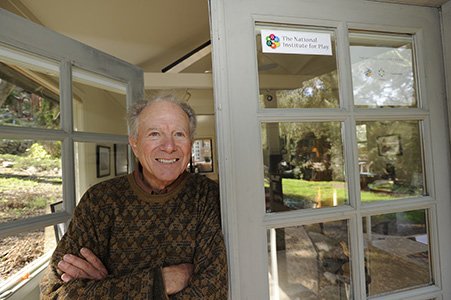
About the expert | Dr. Stuart Brown, MD, is the founder of the National Institute for Play (NIFPlay) and one of the world's foremost authorities on the science of play. A psychiatrist by training, Dr. Brown first recognized the profound consequences of play deprivation through his work on the 1966 Texas Tower Commission, which investigated the largest mass murder in U.S. history at the time. That experience launched a lifelong scientific inquiry — spanning more than 35 years of clinical practice and thousands of developmental play histories — that established play as a biological necessity, not a luxury.
Dr. Brown founded NIFPlay in 1994 to advance the scientific study of play and its role in human health, creativity, and wellbeing. He is the author of Play: How It Shapes the Brain, Opens the Imagination, and Invigorates the Soul (Avery/Penguin, 2009), now translated into 12 languages, and has spoken at TED, Stanford's d.school, and venues worldwide. He remains deeply committed to bringing play into public consciousness as a fundamental requirement for human flourishing.