Story | A Conversation with Angus Fletcher, PhD
/

PHOTO USED with permission from Angus Flethcer, phd
It’s not every day you get to speak with the theorists and thought leaders who have been among the most influential in your work. But this summer, I had the distinct pleasure of doing so. Twice!
In one of the most enjoyable conversations I’ve had, I spoke with Professor of Story Science at Ohio State University, Angus Fletcher, PhD. To kick off this fall’s issue of MAPP Magazine, we’re pleased to share this conversation. In it, Angus and I discussed his own story; where artificial intelligence will always fall short of narrative intelligence; and how we can apply the science of story not only to think, work, and communicate better, but also to live better and richer lives.
Also in this issue, read A Good Story from filmmaker, Capella Fahoome (C’22) and Inheriting Collective Stories by writer and researcher, Mariam Vahradyan (C’24). As a bookend to this issue on the story of flourishing, we’re pleased to share MAPP Magazine’s interview with seminal narrative psychology researcher, Dan McAdams, upon whose research much of what follows in this issue was built.
But first, Angus.
MAPP Magazine (MM): Please share a bit about yourself, your story, and its intersection with positive psychology.
Angus Fletcher (AF): So, a little bit about my history and how positive psychology kind of changed my life and my world—
I started out as a neuroscientist who was just fascinated with the human brain—how extraordinary it was in its ability to come up with just marvelous inventions and medicines and culture. To be so funny and witty. And in my own case, its ability to be so stupid and angry about things that I shouldn't have been angry about.
I wanted to understand the brain and how it works. And so, like most people who are interested in the brain, I got into a neuroscience lab. I was amazed at how reductive our understanding of the brain was. We just treated it like this information processor—a computer, essentially. And we were basically like, oh, when the brain acts badly, it has bad information. There are these glitches called emotions. And when it acts right, it has the truth. But that's not my experience in my brain.
I mean, most people don't know the truth, but they're capable of acting with loyalty and courage. So, I started thinking, what's going on in the brain? A lot of it is the stories we tell ourselves, the stories we tell of the future. Those are always incomplete. A lot of them are imagined; a lot of them are aspirational.
If we have a healthy self-narrative, we're able to incorporate both negative and positive things in a healthy, productive way. If we have a less healthy self-narrative, we ignore too many of the bad things or make things up. It’s really narrative that's driving things, so I wanted to study story. That led me to study storytellers and children, who are just amazing at story. And so, I spent my whole life up until I interacted with MAPP (the Master of Applied Positive Psychology program at the University of Pennsylvania) going around, collecting stories, trying to understand how they worked and what they did.
But because I came from a science background, most of my focus was on how stories solved problems, how stories help you process your grief and that kind of thing. They can even help us with trauma. . . But then, I met James Pawelski. He very famously—at least between the two of us—came up to me at a conference and handed me one of his books. It sort of changed my life.
He was like, “Angus, have you ever heard of positive emotions?”
I was like, “What? Positive emotions? What do you mean?”
“Like joy and love and optimism.”
“Optimism? That sounds dangerous. I don't know about this optimism thing. I'm not sure I'm into optimism.”
And he says, “I think stories could encourage that.”
“That sounds like fantasy. We don't want to encourage fantasy in stories. We want to encourage reality.”
James asks, “Don't you think there's realistic optimism? Do you think a story could actually help you in a healthy way to have a positive outlook?”
And so that began this whole shift in my thinking. I realized that I studied only half of the brain and half of stories.
After I talked with James, the first work I did was on optimism, how classic fairy tales can actually help generate a huge amount of optimism by making us understand that a lot of times good can come from bad. There can be these plot twists in life. And this isn't logical.
In logic, bad comes from bad and good comes from good. So, if bad things are happening in your life, you must be a bad person, and that's just going to make everything worse. But in these classic fairy tales, there could be serendipity. There could be luck. And we've all had that in our lives, where a person who is a kind of miracle just steps into our life at the right moment. They change our lives, and they transform us. And we're just filled with wonder.
Stories remind us to be open to life, to be surprised in a positive way that the world is bigger than you know. It's bigger than your experience. There are good things out there that you can't imagine. This ability to change your story by connecting you to a bigger story—a story you couldn't imagine.
I went through a whole bunch of other positive emotions and started thinking about them and how they could work. And that's led me to this final chapter of my research. I spent an enormous amount of time working with kids on positive things like imagination. How do we get more imagination? Working with campers at the American Camp Association, and how do we get more joy out of life? How do we get more purpose? Recently, I've actually started working with folks from Narcotics Anonymous who are in recovery from addiction.
One of the things that I’ve found really incredible is that there are some addicts who are significantly more joyful than non-addicts. I think a lot of times, we perceive an addict as someone we should pity and feel bad about. But actually, there are folks in recovery who have figured out how to access more joy and more purpose than the rest of us. Why? Because they've been more honest about their story. Because when you go through recovery, you really have to take a hard look at yourself. You have to be honest.
All of that has been opened to me by positive psychology. It's totally changed my life. It has made me a much happier person. My family is much happier with me. I won't say that they think I'm perfect, but I'm a little less grumpy, a little less focused on negative things.
MM: I’m so glad to hear that. Thank you for sharing. I’ve seen you describe yourself as a story scientist, and as we get started, I’d like to make sure we’re speaking the same language. So, as a bona fide story scientist, how do you define story?
AF: A story is an event. It's something that happens. And on the most basic level, a story is a cause and an effect. That cause can be anything. It can be a natural law. It can be a human being. It can be our heart. Our motives. An emotion. At its most basic, a story is something happening. And something happening is two things: one thing that comes before another.
This is why computers can't do narrative. Computers think in equations, and equations always exist at the same time. With computers, you can't have causes and effects; you can only have correlations. But stories can get even more complicated from there. A lot of stories don't just have a cause and an effect. They have a cause and a middle and an effect, or in other words, a beginning, a middle, and an end.
The beginning is the ultimate cause, the origin of the story. The middle is all the things that are kicked off by that. And the end is how it comes to some kind of resolution that satisfies or has some kind of payoff for the audience.
What's really important about narrative is narratives might exist in the real world, but they may also just exist in the human head. As humans, we think heavily in narrative. It's the way we process the world. And it's also a way we create and imagine new worlds.
Another word for a story is plot; it’s a plan. So anytime you're trying to imagine what you're going to do today, that's a story.
We know for sure that stories exist in the brain. They might exist in the world, and they might not. It's hard for us to know as humans. But we definitely think that causality—that cause and effect—probably exists in the world. And there may be bigger stories in the world than human ones.
MM: Makes sense. You wrote a book called Storythinking. What is storythinking, and why is it important?
AF: Storythinking is an attempt to help people understand that the real power of story is not communication.
Stories can be incredible at communicating. In fact, there's probably nothing better for communicating than a story. But that's led people to think that stories are only for communicating and that you use logic and data and then come up with some truth or fact. That the general public is too stupid to understand facts and data, so you have to come up with a story to manipulate them into believing the facts and the data. This account of narrative comes to us very famously from the philosopher Plato who had this negative view of the average person's intelligence.
In fact, the reason that stories are so easy for our brains to grasp is because our brains think in story. It's not because somehow stories manipulate us by creating these emotions which then move our behavior. It's actually because our brains think naturally in terms of causes and effects, in terms of its plans for the day, in terms of What is the story of my life? I mean, anytime you meet a new person, what's the first thing you do? You say, “Hey, where did you come from? Here's where I came from, yada, yada, yada. . .” And then the moment you become friends, you start making plans for all the cool stuff you're going to do together. You don't exchange data and numbers and facts.
Storythinking is the basis of most human intelligence. But we don't study it as the basis of human intelligence. And as a result, we've built educational institutions that aren't nurturing and cultivating storythinking. I think a lot of the time kids spend in school is actually pretty alienating. There’s a lot of shame involved in education because they spend most of it learning things that computers can easily do but are challenging for our brains. Things our brains aren’t evolved to do.
It's like if you took a gym class and the only thing you did in the gym was walk on your hands. It's fine to walk on your hands, but just imagine if all sports required you to be on your hands. You'd spend the entire time feeling like, oh my goodness, I'm so bad at this!
We're sort of making it challenging for people to access their intelligence, to feel good about themselves, to grow organically from how their minds naturally work. And plus, stories are incredibly smart. But because we don't teach storythinking, we have this idea that stories are basically lies and fables and fictions. No, stories are imagination. Stories are possibility.
Imagination and possibility allow us to create new futures. They're the basis of leadership and innovation. They're also the basis of self-growth, your ability to imagine a new story for yourself, and to challenge yourself with a new path, a new adventure.
I wrote Storythinking because I wanted people to understand that story is a real form of intelligence, and there's real value in putting it in the educational system. When you do that, people find it empowering in a positive and healthy way. It’s one part of human intelligence we know is never going to be replicated by AI. So, if people are concerned about either education or about being replaced by AI, invest in storythinking.
MM: Okay, let's go with that! This assertion is definitely one of the things you’ve written that has given me pause. You've written that AI cannot replicate human creativity. In fact, in a 2022 journal article, your exact words were, “no computer AI (quantum or otherwise) has ever learned or will ever learn to produce or process novels or any other kind of narrative” (Fletcher 2022). And then there was lots of other great stuff after that. So, I guess my first question is, four years later, do you still believe this is true?
AF: Oh, yes.
MM: Oh, yes?
AF: Yeah. 100%.
MM: Okay! Then secondly, for readers who are unfamiliar with your work or others who may be skeptical and claim, “Oh yeah, Angus? Well, I just did!” I would love for you to say more about what you mean.
AF: So first, just to establish my credibility on this—because I think it’s an important thing to do—I've spent over 10 years now working in natural language processing, which is the basis of large language models (LLMs), which is the basis of what we mean when we talk about AI. This isn't just some kind of knee-jerk response I had upon encountering ChatGPT. This is based on my understanding of the fundamental mechanics of how these AI work. How they're different from the human neuron. How the human neuron is far more complicated and able to do many more mechanical functions.
You can think of it like the difference between a toaster and a microwave. They just do different things. The human neuron has the mechanical ability to do things which a transistor is incapable of doing.
Now, I know people say to me, “Well, Angus, AI has already written novels.” But AI has not written novels. AI has ingested human novels, detected patterns of words, and then replicated those word patterns. The AI has no ability to generate new narratives because it does not think narratively. And as a result, AI can't write stories that surprise.
The fundamental basis of narrative—and this is how you understand when someone has narrative capacity—is when you're telling a story, you're always looking at how engaged the person is. You’re trying to get the person to hang on to what you're saying so they feel a sense of suspense. That's because you're telling a story piece by piece. They start imagining—wondering what's going to happen next?
The key is for them to be able to see it but not completely see it. To imagine multiple possibilities, because that's what creates suspense. What AI does is the opposite. It does probabilities. It comes up with the word that you're most likely to expect. It kills suspense.
AI is incapable of narrative because it's incapable of generating suspense. That's why the moment you start reading anything that's written by an AI, you immediately feel bored and overwhelmed. Because AI is predictable. Its job is to be predictable.
Can AI be unpredictable? Well, it can insert randomness. And that's a well-known thing that exists in the basis of artificial intelligence. It's a combination of two things we call divergent thinking and convergent thinking.
Divergent thinking is random association of sets. Convergent thinking is putting basic symbolic architectures on top of that. But no storyteller is random. If I started telling you a random story right now, you'd be interested for about 3 seconds, and then you'd be like, “This guy is nuts.” There's no point to this story, right? He's just saying random things like, “The eggplant walked into the room. And then, all of a sudden, tobacco.” It's like, what? Do you know what I mean? That's not a story.
Story is not random, and it's not predictable. But computers are random, and they’re predictable. Those are the two things they can do. So, there is no way for them to do narrative. They're not doing narrative.
When AI appears like it's capable of certain story structures, why is that? It's because a human engineer has gone in and coded a symbolic logic into it, and then words are wrapped around it. What you're getting is essentially a combination of human-engineered software plus an AI. The computer did not teach itself that story structure.
You might ask, “Why does it matter, Angus, whether a human or an AI put the story structure in there? It's still in there.” Well, because again, the purpose of a story is to surprise. The moment that a human puts a story structure in a computer, it's not going to be the surprising part of the story. It's going to be the familiar part of the story. And so, the part of the story that actually involves storytelling is going to be left with the computer, and it's going to be inept at it. As a result, you’ll be left with something that seems kind of formulaic and then boring.
So generally, when humans use AI to write novels—which, by the way, is a terrible idea. Don't do that—it's bad for your readers. It's bad for you. It's bad for the environment. It's bad for everything. Don't do it. But when people do, they come up with the story themselves, and then they prompt the AI to write it.
Let's say I'm imagining a scene in which this thing happens and that thing happens. And then the computer will just take a bunch of language from other stories that are similar and put that over the story structure that you've created. So that's about as close as you can get in terms of an AI novel. But then the writing is boring, and the characters' voices are boring, and everything is predictable. And does it make it faster to produce? Yeah, but don't we already have too much stuff anyway? I mean, isn't it literally the problem with the world right now that we're being bombarded with words and text? Do we need more, or do we need less? Thoughtful, curated, human, intelligent writing.
AI is never going to do a novel. AI is never going to replace humans in any of these fundamental ways. Instead, what it does very tragically is plagiarize, exhaust, confuse, create panic, create unnecessary anxiety. It's just a bad thing.
Actually, I’m very confused as to what the positive function of AI is. You know, like if you asked me the best use case for generative AI. These AI are destroying schools. They're negatively affecting young people. They're very bad therapists. They create monstrous emails, which take everyone forever to read.
If you're just going to use the thing to summarize a conversation, that's okay. But beware because it’s going to miss out on the most interesting parts of the conversation. It's literally going to take the most obvious parts and put them together. But is that what you want to remember from your conversations? The obvious parts or the surprises?
I’m very skeptical. I mean, it's part of this pathology in the modern world to put productivity and optimization ahead of joy and growth.
MM: Yes. Well that, what you just shared, that was—surprising.
AF: Well, I hope you're not starting an AI company.
MM: [Laughs] Yeah, no. Not even kind of! I will say it's a refreshing perspective. Not one I’ve heard very often.
AF: Well, I'll tell you something: You're going to be hearing that perspective a lot more in five years because it's accurate.
MM: OK, I hear you.
AF: And all of this AI stuff is going to go away. And in its wake, it's going to leave a lot of tragedy. But it's going to go away.
MM: And what about literature? You've also written about literature and how literature can support mental health. How it can support flourishing. Can you share more about that?
AF: Yeah, absolutely. To start, literature doesn't have to be a big fancy thing. It doesn't have to come from 2,000 years ago. The point of literature is to help you explore characters who are different from you, worlds that are different from yours. It provides a chance for you to stretch your imagination. To use your emotions. It's this wonderful technology that humans have developed that captures so much of human experience in a simple, straightforward, easy-to-access form. And unfortunately, very little of it is being read anymore.
We know that young people have almost entirely stopped reading. We know that nowadays, if people don't start reading when they’re young, they don't start reading ever. This is the opposite of the way it used to be a few hundred years ago. Then, people really wanted to learn how to read. Now, it's like they never learned to read.
We also know that even when young people do start reading, they often stop around the age of 12, 13, or 14. And by the time they're in college, they're almost exclusively reading online things or whatnot. They’re depriving themselves of an opportunity to develop their brains, because on a basic level, when you read a novel, you connect to someone else's experience.
The main character of that novel—you get to walk through their life. You get to imagine how you might respond in their situation. You get to ask, “Would I do something differently?” It's a wonderful opportunity for you to start to figure out your own story and your own narrative by comparing your own responses to what that person does. It's also a tremendous opportunity to learn how to access and process your own emotions.
One of the things we know is that young men are much less likely to read than young women. We also know that young men are having a much harder time with their emotions than young women. And reading novels requires emotional work.
Recently, I taught a class of young, mostly male engineers. They asked, “Why would we read these novels? They make us cry.”
And I was like, “That's the point! They help you access these things. They help you grieve.”
“But we're grieving things that aren't real.”
“No actually, that story is helping you connect with your own grief. It's helping you process your own grief.”
We know there's this function called autobiographical recall, which is a fancy way of saying that when you hear someone else's story, it automatically makes you think of your own.
If you're reading a story about grief, it's helping you access your own grief. If you're reading a story about a traumatic experience, it might help you process that experience in some way. And there are all sorts of other experiences.
Oftentimes, when I tell people that I like positive psychology, they're like, “Oh, you're one of those positive people. Everything's positive all the time.” But I'm like, “No, that's not the point of positive psychology.” The point of positive psychology is that even bad things are good. What we do in positive psychology is we own bad things. We own tragedy. We own grief. We own pessimism. We own the fact that our history is not perfect. We own the fact that the history of our country is not perfect. We own all of those things because we see it as a source of growth. We're the true optimists. We know that everything, even the bad, is good.
The same thing happens when you’re reading. You’re learning to go back and find hard things in your own past, process them, turn them into growth, turn them into wisdom, turn them into emotional strength. We all know it's common for our wisdom to come from hard times. For our emotional strength to come from challenges. Stories help us access that and build it into our narrative so that instead of being ashamed of our past or repressing our grief, we learn how to make it part of ourselves. That's why literature is the ultimate therapy.
You can have a very, very good therapist, but in general, most people grieve more deeply when they're reading a memoir. If you lose a child, reading a memoir about someone else losing a child can help you process. That’s why literature is so important. It helps us grow and achieve our emotional fullness.
If you're a young person, literature can help you imagine. I mean, we all got into reading books in the first place, I think, to the extent that we read books, because we were like, “Oh my goodness! There are other worlds to explore. And in those worlds, I can be anything. I can do anything.”
At the moment, the modern world is very oppressive. It seems to be telling us the opposite. It's telling us that humans can't do anything. That we’re useless and going to be replaced. . . But actually, each person has the ability to change the world. It comes from your imagination. And that comes from your child self, which is activated by reading literature.
So anyway, it's a very long answer. But when I talk about literature, that's what I'm talking about. I'm talking about that opportunity to read these stories that help you grow your own story.
MM: You’re speaking the truth, Angus. Preach! Thank you very much. Just a bit ago, you talked about grief and about struggle. About conflict. To your earlier point, if I say, “Potato, and then all of a sudden, eggplant.” That’s not a story, right? But conflict, that's the thing that moves story along. It's how characters develop. It’s how plots move. In stories, conflict is everything, right? And without it, there's no story. So, as you see it, in the stories of real life, how does that translate?
AF: Well, one of the basic things that stories help us understand is that conflict is not always bad. Conflict can be destructive. It can be bad. But conflict can also be healthy and productive. I mean, so many of our moments of growth come from inner struggle. We're torn between two ways of feeling or we're torn between our heart and our mind and we're struggling.
Our relationships are built on conflict in a healthy way. Because you don't want your partner or your friends to be the same as you. You want to be different. When you're different, you struggle, but in a good way. You debate and you disagree and you wrestle emotionally with each other. And that helps you grow, and it helps the other person grow. You don't become like each other through conflict; you develop more into yourself.
In the modern world, we’ve become so terrified of difference. We think that we have to be emotionally safe by making everybody the same as us. But that's not how you grow. You grow by encountering people who amaze you and challenge you and make you realize, oh my goodness, this person has a different way of thinking than I do. Then you might reconsider your own point of view. So, conflict can be a really, really healthy thing. And it is the basis of every story.
At the most elemental level, a story is usually about a person in conflict with their world. And isn't that all of our stories? I mean, don't we all feel on some level a little bit alienated or at odds with the world? And don't we want to change the world in some way to make it better in the way that we see it? I mean, that's the goal, certainly, of every artist. And then, part of that is realizing that the world isn't perfect, but I've got something to learn from the world. So, as I'm changing the world, the world is changing me.
In very simple stories, conflict is always between good and evil. One side has to defeat the other. But in almost any story that sticks with you, you start to realize that conflict is usually between two good things. That's the most powerful kind of story.
How much of our lives do we spend saying I'm good and that person is evil? But really, I'm good and they're good too. Figuring out ways to harness difference is a lot of what we learn from stories.
MM: So, a lot of our readers are practitioners. And this program, MAPP, is all about application. So, what does one do with all of these knowledge bombs, Angus? What does it look like in practice to take some of the things that you’ve spoken about and live them?
AF: So maybe I'll give just a few possible things.
MM: Yes, that’s perfect.
AF: So, first of all: Read more stories. Read stories that challenge you. Don't keep reading the same kind of story all the time. If you're having a bad day, it's completely legitimate to read a story you've read a million times before. But over time, you want to be reading memoirs by people who are different than you or novels from different cultures or different time periods or plays that you don't initially understand. That's where growth happens. So, go out there and find new stories, encourage new stories, and be part of that human process of growing the library.
The second thing: Know your own story. Your own story is the most powerful thing in your life. The story that you tell yourself about yourself determines your future, your possibilities. And the way you find that story is by going back to your past, being honest about your past, but integrating your past, so you can start to see how even the bad things that happened in your past were part of a larger story of growth, development, wisdom, and strength. Then, start to open your story to the future. Start to realize that there are many possible paths you could go down. Your own story is usually strongest when your past is integrated and your future is branching.
Finally, we can talk about communication. People are always asking me, “How do I use stories to communicate?” So, I'll give a couple of practical tips on stories and communication.
Stories are about action, not about information. People misuse stories when they try to convince other people to memorize a million things. Your brain can retain information from a story, but only if it's helping you do something. You’ll always remember the parts of the story that help you do something or that make you feel something. So, when you're telling your story, remember, you're just not going to convey a lot of facts. The other person's brain isn't interested in those specs. They're interested in what your story will do with their story. So, focus on that action.
Be honest. Plenty of people tell lies in stories, and if you want, I can talk about truth and lies in a second. But honest stories are usually better because they work and they're never going to get overturned. An honest story is a story forever.
Have a clear destination. This is the difference between stories and logic. Computers, transistors, think in lists. But when we think about story, we think about the destination. Where's this going? You'll notice that a story becomes less interesting to you if it's just going in a bunch of different directions. When you can't figure out how things fit together. It gets more interesting when you realize, “Oh, this is where it's going.”
Spark emotion. No matter how clever a story is, if it doesn't move the heart, it's not going to last with people very long or engage them very deeply. The easiest emotion to access is fear, but it's also the weakest. Hope is a great emotion. Empathy is a great emotion. Joy is a great emotion. And love—it’s very simple to evoke love through a story. How do you do that? You share a dangerous secret. If a character discloses something that makes them vulnerable, it sparks love. These are all positive emotions you can generate through stories.
MM: These are great, Angus. Thank you! You mentioned truth and lies. Was there more you wanted to say there?
AF: Well, I just say this because I think a lot of people think of stories as marketing: “What do I say to get the other person to do what I want them to do?” Essentially, “How do I use the person? How do I manipulate the person? How do I hijack their agency and take away their story by giving them a false story, by betraying their trust?”
The reality is that you can do that. You can lie. I mean, part of the reason I think humans are wonderful is that we tend to be quite trusting.
You might say to yourself, “Well, I should take advantage of that.” And certainly, all around us we see lies put into narratives and used to control people. We may think, “Well, to fight that, I've got to tell my own lie.”
I just want to put it out there that, yes, lying can be effective, but so can truth. Truth can be very effective. And in the long run, truth is more effective because it's unbreakable. Again, you can't take away an honest story. It's going to live forever.
For a long time, psychologists had this idea called nudging where they would basically say, people are too stupid, so we'll just kind of nudge them by manipulating them in various ways. But I would say, look, your audience trusts you. Trust your audience.
Human history is full of stories that have taken a while to catch on. But when they caught on, they had a huge effect because they were honest and they lasted. Honesty is different from truth in the sense that as a human, as a storyteller, you may not know the full truth. But you know when you're being honest. That's something you can always feel in your heart because it's bigger than you.
MM: As we start winding down, I'm curious: What are you reading these days?
AF: I'm reading a lot of sobriety narratives. And it's a strange thing for me because I'm not an addict. In fact, when it comes to drugs and alcohol, I'm the most boring person you could imagine. I've never even had a glass of alcohol in my entire life. But I've been deeply affected by addiction in a lot of ways. I mean, people I care about have been really affected by addiction—really, really deeply.
I’ve been moved to tears by seeing folks in recovery and just how extraordinary they are. Their strength and their wisdom. How much love they have. How much joy they have. How much purpose they have. And I started to realize that there's something about recovery, which is the secret, I think, to joy.
In the modern world, we confuse joy with pleasure and happiness. Pleasure and happiness come from the reward network in the brain, which is connected essentially to dopamine. But joy is connected to our emotions. It's a totally different neural system.
When you read these addiction memoirs, to me anyway, there are these moments of incredible grief and then incredible joy. You feel yourself in terms of your own struggles and triumphs—which are so much smaller than those of the folks writing these memoirs—but you feel them again and you feel strengthened. You feel like you have more joy in your life. Like you have more purpose in your life. You have more gratitude for negative things. And you have more love for things you don't understand.
These are the kind of paradoxical powers of gratitude and love—to help us take negative things and turn them into positive things. So that's what I've been reading. I don't have any specific recommendations because a lot of the ones I've been reading are clinical interviews. But I would definitely say to folks that if you haven't read an addiction memoir, I think you might surprise yourself with how much positive emotion it triggers in you.
MM: Yes, I hear that too. Is there anything more you’d like to share before we finish today?
AF: No, I mean, this has been incredible. I guess my parting advice, as I said before, is that your story is the most important story. But once you’ve found your story, there's nothing more important you can do than help other people find their story.
MM: Ah, yes. How can our readers learn more about your work?
AF: I've written a lot of very long books. So, if they want, they can read any of my books: Storythinking, Primal Intelligence, Wonderworks. I’ve also been on a bunch of podcasts and whatnot. The one that people seem to like the most is the one I did recently with Rick Rubin. Rick unnerved me by not saying anything. So, I over-disclosed the entire interview. I said things that I normally wouldn't say in public. So, people find that kind of fascinating. Yeah, there are some podcasts, or if you want, you can check out the books.
MM: Alright, well thank you so much for such a rich conversation. It was moving. Very moving.
AF: Honestly, it's been just a pleasure and an honor. I mean, this is the most fun I've ever had doing an interview. I felt really connected.
MM: Oh, good, Me too! You were speaking my language on so many levels. . . Thank you so much for your honesty. For sharing your story and truth. I think it's hard not to be moved by the truth.
AF: I try. I will be honest, though, it's so much easier when you're a professor. We're allowed to speak the truth. I wish everyone was.
MM: Yes. Well, this has been really great. . . Thank you, Angus.
References
Fletcher, A. (2022). Why computer AI will never do what we imagine it can. Narrative, 30(1), 114-137. https://dx.doi.org/10.1353/nar.2022.0006.
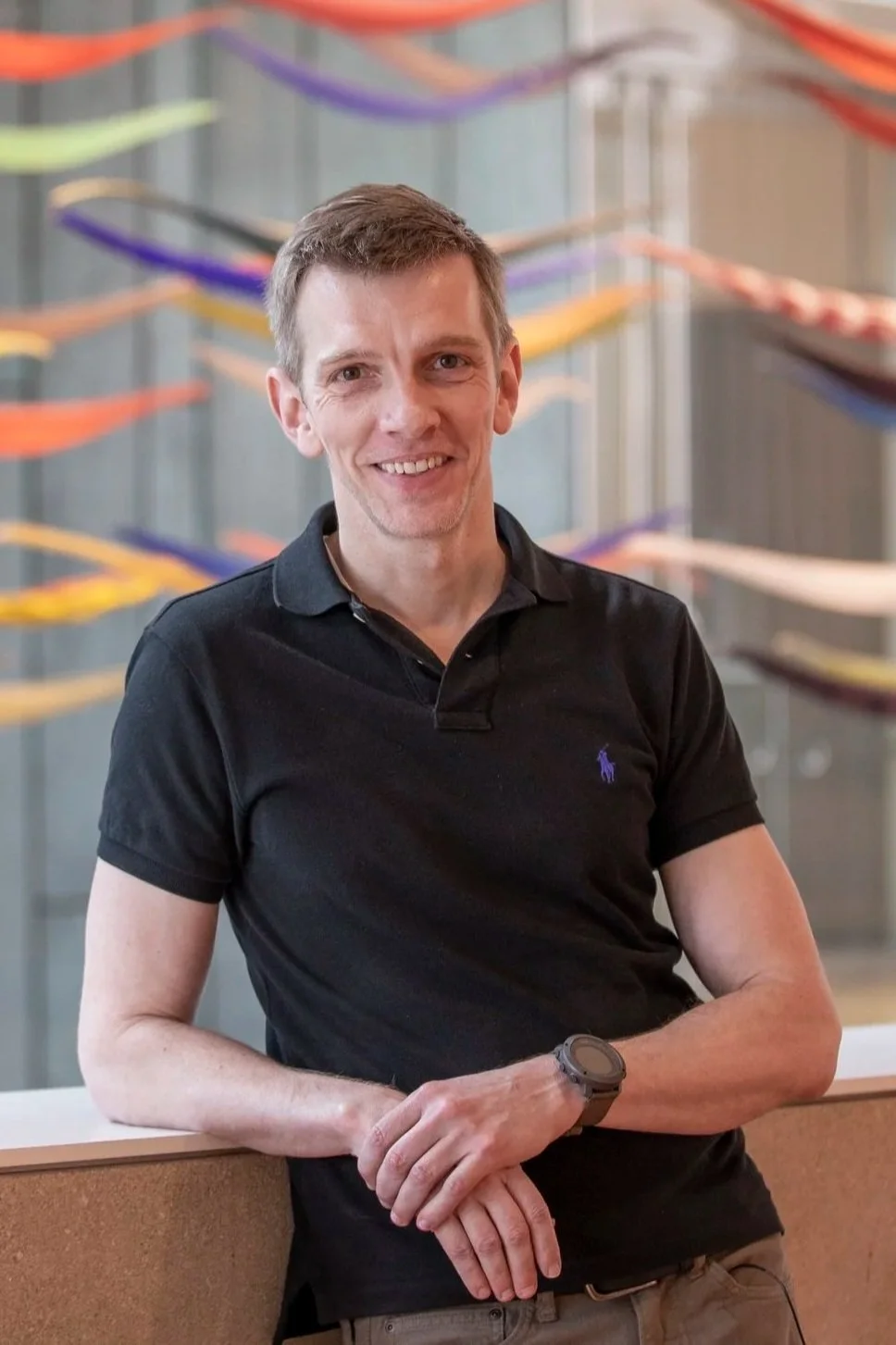
About the expert | Angus Fletcher received his PhD from Yale and is Professor of Story Science at Ohio State University. His research has been called "mindblowing" by Malcolm Gladwell, "life-changing" by Brene Brown, "groundbreaking" by United States Army Special Operations, "wow" by Rick Rubin, "the next Aristotle" by Antonio Damasio, and "the next Freud" by Martin Seligman. His most recent book is the instant national bestseller, Primal Intelligence.